The State-Of-The-Art Yacht Design Office
by Jay R. Benford.
In the early 1960's, when I entered the profession of yacht design, high-technology was represented by the ability to
use a slide rule and a planimeter. I'd gotten acquainted with the slide rule earlier - and still use one for some
calculations today. In a moment of shopping abandon, I splurged just over $40 and bought a planimeter. I quickly got
onto using it and it still does faithful work for me today.
However, in the intervening decades electronics has taken the design world by storm. In the early '70s I got an HP-35
shortly after Hewlett-Packard brought out the first "shirt pocket calculator". It caused a revolution in the amount of
work we could get out and the degree of accuracy we could attain.
About this time Bill Plice, a local computer programmer and sailboat enthusiast got into programming some yacht design
programs and offering to run these at a reasonable cost. This got us into refining the offsets in the computer and coming
up with more elaborate stability studies than we could otherwise afford the time to do manually. In the meantime, the
price of computing power continued to drop and the availability of better design hardware and software expanded.
So, wanting to stay in the yacht design business for the long haul, I came to the conclusion that computerizing the design
office was the best way to stay in business. This led to an investment over a thousand times as great as that planimeter
a generation before. Fortunately, I'd been able to keep the business growing by investing back in the business. It's both
a pleasure and honor to be among the very few who are able to make a living at doing something they love in the field of
yacht design.
This major investment in the beginning of 1986 has led into another revolution in the way we do our design work. George
Hazen's FastShip software that we use is very quick and adept at hull form creation and modification. We start by
creating a basic hull form on screen and then proceed to manipulate it into the size and detailed shape that we're seeking.
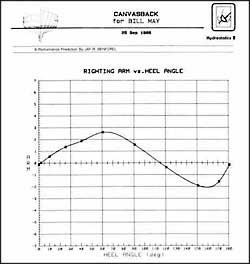
Along the way we can take quick looks at the displacement, curve of areas, stability and coefficients.
If we want a more detailed check on the stability of the form, we can move into another section of the program and run
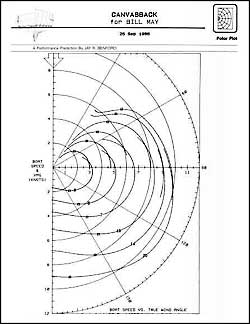
full Hydrostatics. If it's a sailboat, we can approximate the rig and run it through the Velocity Performance Prediction
(VPP), generating polar plots of sailing performance in varying wind strengths. These can be continually refined
throughout the design process so that we can meet whatever goals we set for ourselves.
We also use the Performance Prediction to check pre-computer designs and use them for a basis of comparison with the new
boats being created, or just to see how well we did creating a good design. We're using this capability now to do some
revisions and updates on some of our older designs, improving their performance and still retaining good stability and
safety characteristics.
FastShip also has the capability to design truly developable surface forms, making it ideal for doing steel, aluminum
and plywood designs. When the hull form is created it is then possible to "unwrap" the surfaces, giving the flat plate
layouts for the surfaces of the hull form. In years to come we'll see more builders taking advantage of this with
computer driven numerical controlled cutters doing the work. Some of our builders are now computer cutting parts for
the boats.
Spar and rigging design and analysis is another capability of the computer system. The computer can do a much more
sophisticated design analysis than was practical with hand-held calculators and we can get this output as data that is
usable by the client and/or builder.
Design of fin keels and the optimization of their shape and placement relative to the rig and hull is another program we
can do. This lets us look at a lot of variables and optimize the keel. Then, we can turn the plotter loose and draw out
the foils full size, if desired, for the builder.
Once we're done with the final version of the hull, we can turn to the plotter and generate full-sized templates of the
new design. These have proven very accurate in the builders' shops and a great time-saver. If the builder still wants
to check the lofting himself, we can provide offsets with the same high degree of accuracy.
Our FastShip computer system is truly the state-of-the-art for contemporary yacht design work. We've also been
able to use it to advantage with more traditional types and in updates to our older designs. I expect that we'll
continue to expand the system and its capabilities over time so that we can keep providing the best yacht design work
in a quick and timely manner.
|
|